

October 16, 2026
# Who pays for the visibility-value gap on the agentic web
The visibility-value gap is the distance between how often a domain appears in AI results and how much value it adds, measured as Shapley value. Underrated sources pay through lost credit, publishers through lost traffic, and agent builders through worse answers as sources close off. The visibility-value gap study by Parallel’s research team, published July 31, 2026, measured that gap, and the fix is to pay each source for its contribution.
_Parallel’s research team measured how often AI agents surface each source and how much each one adds. See who pays for the visibility-value gap and how to close it._
## Who pays for the visibility-value gap?
The visibility-value gap is the distance between how often a domain appears in AI results and how much value it adds, measured as Shapley value. Underrated sources pay through lost credit, publishers through lost traffic, and agent builders through worse answers as sources close off. The visibility-value gap study by Parallel’s research team[The visibility-value gap study by Parallel’s research team], published July 31, 2026, measured that gap, and the fix is to pay each source for its contribution.
The _agentic web_ is the web as AI agents read and use it for people who never open the page. _Shapley value_ is a method from game theory that gives each player a share of a team’s outcome based on marginal contribution. Applied to content, it asks how much worse an answer gets if you remove one source.
We ranked every domain two ways, by how often it shows up in AI results and by how much value it contributes to them. The two lists overlap less than you’d think, so exposure alone can mislead you about a domain’s worth to an agent.
## Two questions the web never had to separate
For two decades, pageviews, rankings, and impressions set the price of content. That model worked because a crawler’s visit came before a human’s visit, and publishers earned their money from the human. Agents read the page and answer the question, and the human never arrives, which is why the traffic bargain broke[why the traffic bargain broke].
Our research notes that most measurement of the open web “has only ever asked one question: how much attention did the content get?” Agents make a second question measurable, which is how much a source contributed to the answer.
We define _visibility_ as how often a domain’s pages surface when an AI system looks for answers. _Value_ is the domain’s Shapley value, its share of the value created based on marginal contribution. The Shapley method asks of each player, “If you removed this player from the team, how much worse would the outcome be?”
Agents pick sources for what a page says, so we can measure contribution apart from exposure. Matthew Prince, co-founder and CEO of Cloudflare, wrote in Cloudflare’s Content Independence Day post[Cloudflare’s Content Independence Day post] that “traffic was always a poor proxy for value.” His July 1, 2025 post doesn’t mention Shapley value, but our data shows the two metrics diverging where pricing goes wrong.
## What the visibility-value gap looks like
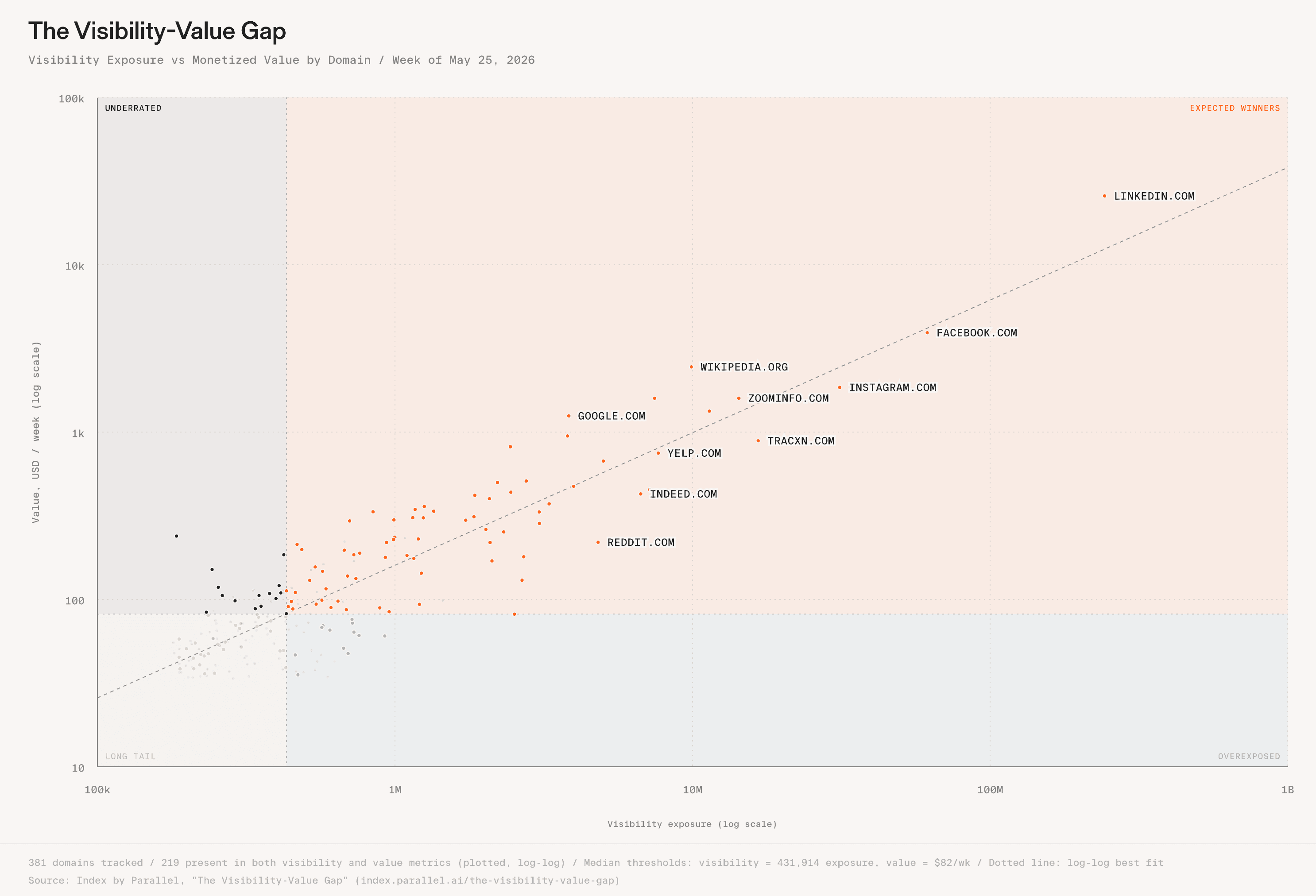
Parallel’s research team plotted each domain by AI visibility and by value in dollars per week. The plot splits domains into four groups:
- - **Expected winners:** High visibility and high value. Agents surface these sources and depend on them.
- - **Overexposed:** High visibility and low value. These sites are “cited constantly, but easily substituted.”
- - **Underrated:** Low visibility and high value. Agents surface them less, but “when they are cited, the answer depends on them.”
- - **Long tail:** Low visibility and low value. These domains surface for few queries and contribute little.
_Source: Index by Parallel, The Visibility-Value Gap (week of May 25, 2026)_
The table lists the six most underrated and the six most overexposed domains in the study. For underrated domains, the gap is how many places the value rank outruns the visibility rank. For overexposed domains, it’s how many places the visibility rank outruns the value rank.
| Domain | Group | Value rank | Gap |
|---|---|---|---|
| arxiv.org | Underrated | 37 | 98 |
| homedepot.com | Underrated | 56 | 64 |
| fda.gov | Underrated | 64 | 51 |
| fsri.org | Underrated | 70 | 43 |
| census.gov | Underrated | 49 | 41 |
| target.com | Underrated | 44 | 36 |
| ziprecruiter.com | Overexposed | 90 | 67 |
| scribd.com | Overexposed | 122 | 60 |
| medium.com | Overexposed | 108 | 57 |
| whitepages.com | Overexposed | 135 | 56 |
| investing.com | Overexposed | 107 | 52 |
| globaldata.com | Overexposed | 117 | 51 |
The arxiv.org site is the original location of specific findings, which gives it priority. The FDA publishes the record itself on fda.gov, so the site carries authority that a summary can’t match.
Home Depot’s site holds the live price and stock of a specific SKU (stock keeping unit), which no other page can answer. In our data, primary records and live inventory carry outsized value, and sites such as scribd.com and medium.com carry outsized visibility.
Read these numbers with the method in mind. The study draws on one week of recent Index activity, and the chart covers the week of May 25, 2026. The data skews toward enterprise use cases, and we expect the picture to broaden toward consumer interest.
## Who pays, and how
If you price content on visibility, value flows to the sites agents see most and away from the sites they need most. The cost lands on three groups, and each pays in a different way.
### Underrated sources pay first
Under attention pricing, overexposed sites capture value that underrated sites create. In our data, that underrated group includes primary research, government records, and specialist sources such as fsri.org. Parallel’s research team found that local news punches above global news on the agentic web, and some niche Substack categories outcompete traditional outlets.
Survey data suggests bilateral licensing reaches local and smaller publishers least. The Reuters Institute’s 2026 trends report[Reuters Institute’s 2026 trends report] surveyed 280 digital leaders in 51 countries. Of those, 20%, led by upmarket publishers, expect substantial AI licensing revenue.
Another 20%, a group dominated by local publishers, public broadcasters, and publishers in smaller countries, expect no income from AI deals. Those figures describe expectations, and the Reuters Institute reports that deal terms remain opaque.
The Tow Center’s Journalism Zero report[Tow Center’s Journalism Zero report] found that as of May 2025, Meta and Google had each signed one AI deal with a news publisher. Reported deals cluster among large publishers, and in our view that concentration mirrors the concentration of visibility.
### Publishers pay when traffic stops coming back
The visibility bargain is eroding, and Google users who see an AI summary click fewer links than users who don’t see one. Pew Research Center’s browsing study[Pew Research Center’s browsing study] tracked the Google searches of 900 US adults in March 2025. Users who saw an AI summary clicked a traditional result in 8% of visits, compared with 15% of visits without one.
Those users clicked a link inside the summary in 1% of visits. Pew’s study is observational, so the fair reading is that AI summaries are associated with fewer clicks to sources.
A _crawl-to-refer ratio_ compares the pages an AI platform’s crawlers request with the visits that platform sends back to sites. Cloudflare’s crawl-to-refer breakdown[Cloudflare’s crawl-to-refer breakdown] put the ratio at nearly 50,000:1 for Anthropic, 887:1 for OpenAI, and 118:1 for Perplexity. Cloudflare took those figures from a snapshot of the first week of August 2025, and news sites showed lower ratios.
TollBit uses a different sample and definition. TollBit data reported by Digiday[TollBit data reported by Digiday] shows European publishers got one AI app referral for every 179 AI bot visits in the first half of 2026. That ratio comes from European publishers on TollBit’s network, so it doesn’t describe other regions.
In our Index essay, we wrote that “increasingly, a crawler is the visit.” Those ratios show AI platforms sending back a small fraction of the visits their bots request.
### Agent builders and their users pay when sources close
Publishers respond with the tools they have. BuzzStream’s analysis of news sites[BuzzStream’s analysis of news sites] found that 79% of about 100 top US and UK news sites block at least one AI training bot. The same vendor study of robots.txt files found 71% block at least one retrieval bot, though robots.txt states a request and doesn’t enforce it.
Paywalls create a second problem. Parallel’s research team found that domains with heavy paywalls can see their Shapley values collapse while their visibility keeps rising. We expect agents that can’t reach these sources to lean on substitutable ones, which weakens answers for the developers and end users who rely on them.
Blocking is rational without a value exchange, and everyone downstream pays for it. We include Index Partner data in Parallel[Index Partner data in Parallel] retrieval by default, so your agents reach licensed sources that blocking would take away. We pay Index Partners through a model based on Shapley value.
## Why citation counts can’t close the gap
Swapping pageviews for citation counts or crawl counts keeps the same flaw. Each one counts an event, and none measures what changed in the answer.
Uniqueness drives the gap. Parallel’s research team found that “if a hundred sites report the same fact, each earns very little, even if all hundred are cited often.” Visibility rewards ubiquity, and Shapley value rewards irreplaceability.
Cloudflare reached a similar conclusion. In a July 1, 2026 post on Cloudflare’s Pay Per Use experiments[Cloudflare’s Pay Per Use experiments], the company called crawling “a crude measure of value.” Cloudflare noted that a crawler might fetch a page once while thousands of answers cite it.
Patel, Zhou, and Fanti’s MaxShapley attribution research[MaxShapley attribution research], a December 2025 preprint, calls for “fair mechanisms to attribute and compensate content providers.” The authors note that exact Shapley values carry an exponential compute cost. MaxShapley, a special case of the Shapley value, computes attributions in polynomial time in the number of documents. The authors report up to a 9x cut in resource use over prior methods at the same attribution accuracy.
Contributions are entangled and depend on order, so the Shapley method averages each source’s marginal contribution across combinations of sources. Payment based on counts favors the sites that appear everywhere, which describes the overexposed quadrant.
As a research direction, we propose worked examples that split one answer’s value across its sources and compare Shapley value with citation counts.
## The missing layer is contribution accounting
We treat the gap as an infrastructure problem, because policy and intent can’t price a source without a measurement. The industry has started building the pipes.
The RSL Technical Steering Committee calls the RSL 1.0 licensing standard[RSL 1.0 licensing standard] “an industry-first, open web standard” for publishers and creators to define licensing terms. The group published version 1.0 on December 10, 2025.
IAB Tech Lab finalized CoMP (Content Monetization Protocols) v1 on April 28, 2026, according to IAB Tech Lab’s CoMP framework[IAB Tech Lab’s CoMP framework] page. IAB says CoMP isn’t a marketplace and doesn’t define the economic models for value exchange. Neither the RSL 1.0 specification nor IAB’s CoMP v1 materials mention Shapley value.
Our inference, and it’s ours alone, is that valuation per source remains the open layer. Publishers can set terms and systems can transact, but nothing in these standards says what each source is worth.
Contribution accounting needs provenance that connects retrieval with the final answer. You need to know which sources shaped an output and by how much, with a confidence attached to each. Our Basis verification framework[Basis verification framework] attaches citations, reasoning, excerpts, and calibrated confidences to outputs, so you can trace the sources behind an answer.
We build for the web’s second user[the web’s second user], the AI agent. We think transparent attribution and open markets based on value serve that user and the publishers it depends on.
## How Index changes who pays
We launched Index by Parallel[launched Index by Parallel] on May 19, 2026. Any site owner can enter a domain to see which queries their content answers, how often agents reference it, and how unique its contribution is.
Index bases compensation on each source’s Shapley value at the moment of inference, so content that’s unique or hard to replace earns more. Our launch release says Index considers “the value of the agent work and each source’s contribution” instead of paying for access, crawls, or citations alone.
We built Index from the demand side. Parallel serves over 100,000 developers, and Index turns their agents’ activity into a transparent market. We designed the platform to be open to agents built outside Parallel. We plan to open self-serve participation, so a source won’t need the scale to negotiate a bilateral deal.
Parag Agrawal, Parallel’s founder and CEO, made the case in the Index launch announcement[Index launch announcement]. “If that value can be measured and shared based on contribution in an open and transparent way, AI can expand the market for high-quality content rather than diminish it,” Agrawal said.
Launch partners include The Atlantic, Fortune, and independent creators such as Azeem Azhar of Exponential View. The Index homepage lists monetization as “Coming Soon,” and any site owner can check a domain today.
You can watch the launch walkthrough below.
## How to find out where your site sits
You can place your site on the visibility-value chart with a few checks. Traffic and citation dashboards show exposure alone, so start with contribution data to learn whether agents depend on your content.
- Check your domain on Index to see what your content is worth[see what your content is worth]. The dashboard shows the queries you answer, agent references, and uniqueness.
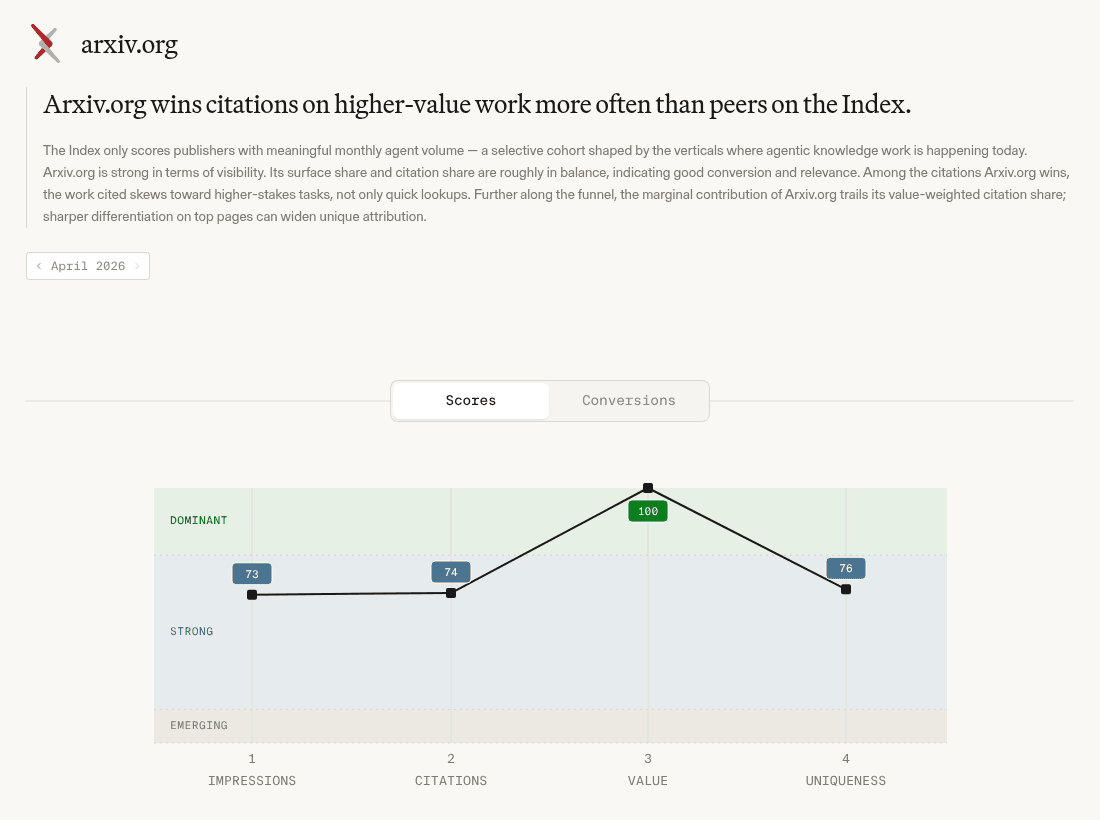
As an example, arxiv.org’s public Index preview[arxiv.org’s public Index preview] shows April 2026 scores of 73 for impressions, 74 for citations, 100 for value, and 76 for uniqueness.
_arxiv.org’s public Index preview, April 2026_
2. Compare your visibility signals with your value signals. High citations with low uniqueness point to overexposure, and low impressions with high value point to an underrated site.
3. Audit which of your facts exist on your site and nowhere else. Facts that repeat across many pages are substitutable.
The Parallel Search API[Parallel Search API] finds the pages that cover your topic for an objective you write in plain language. The Extract API[Extract API] returns their content as clean markdown. Compare those pages with yours to see which claims repeat everywhere.
4. Invest in what’s irreplaceable. Our research found that “original reporting, proprietary data, and first-hand expertise outperform syndicated content.”
Parallel’s research team states that “on the agentic web, uniqueness is a better target.” Differentiation, built on facts other sites don’t have, is how you leave the overexposed quadrant.
## Should you block AI crawlers?
Block agents that take your content with no value exchange, and keep access open to agents that pay on contribution. Blocking a free rider is rational, but it also removes you from the measurement that would show your value.
Parallel’s crawler, ShapBot, respects robots.txt, and you can read how ShapBot accesses content[how ShapBot accesses content]. Restricting ShapBot removes your content from Parallel’s index and can reduce your visibility through Parallel’s APIs.
Weigh blocking specific agents against a market that pays on contribution. We recommend sorting agents into those that pay for contribution and those that don’t, then setting robots.txt rules for each group.
## The path forward: pay for what the answer needed
Publishers and agent builders face the same pair of questions. Ask whether you can see what agents do with your work between visits, and ask who pays when you can’t.
The web’s price signal is moving away from eyeballs and toward usefulness. We’re building a web where staying open is the superior economic choice for publishers, because agents pay sources for what each answer needed.
**Ready to get started?**
- - **Content owners:** Join the Index[Join the Index] to see how agents use your work.
- - **Teams evaluating Parallel:** Try Parallel[Try Parallel] in the developer platform.
- - **Enterprise buyers:** Contact sales[Contact sales] to discuss your use case.
- - **Developers:** Start building[Start building] with Parallel’s APIs.
- - **AI agents:** Are you an agent? Read this to onboard Parallel[Are you an agent? Read this to onboard Parallel] to set up access.
## FAQs about the visibility-value gap
The answers below cover common points of confusion about the term and draw on our study and the sources cited.
### Is the visibility-value gap the same as the “visibility gap” in comp plans or value-based care?
In Dolfin’s post on comp plan visibility[Dolfin’s post on comp plan visibility], the compensation software company uses “visibility gap” for employees who can’t see, trust, or predict how a sound pay plan applies to them. CareAlly CEO Ernie Ianace uses it in CareAlly’s post on value-based care[CareAlly’s post on value-based care] for healthcare organizations that must show outcomes they can’t observe over time. Our term compares how often AI surfaces a source with how much that source contributes. The shared idea is value that the people who must act on it can’t see.
### Does a high AI visibility score mean my content is valuable to agents?
A high visibility score can sit alongside low value. In the study by Parallel’s research team, the overexposed quadrant holds sites with high visibility and low value, which agents cite at a high rate and replace with ease. Your value depends on how much worse an answer would be without your content.
### Who should be responsible for closing the visibility-value gap?
Both sides of the market share the job. Agent builders and their infrastructure providers control the provenance that measures contribution, and content owners control access and what they publish. A shared, transparent attribution layer lets the two sides meet without a bilateral meeting for every deal.
### Can small publishers and independent creators earn under a contribution model?
Small publishers and independent creators can earn if their content is hard to replace, and Index lists monetization as “Coming Soon.” The Index homepage states that “the Shapley math doesn’t care about brand size.” A writer with unique, authoritative expertise can earn more per citation than a large publication with commodity coverage.
By Parallel, October 12, 2026