
Sep 28, 2026
- [Connect Lovable apps to the live web with Parallel](https://parallel.ai/blog/lovable-parallel)
Author: By Parallel
May 16, 2025
A new standard for verifiable AI web research
A month ago, we launched the Parallel Task API, powered by a series of processors that offer state of the art accuracy on web research tasks at every single price point.
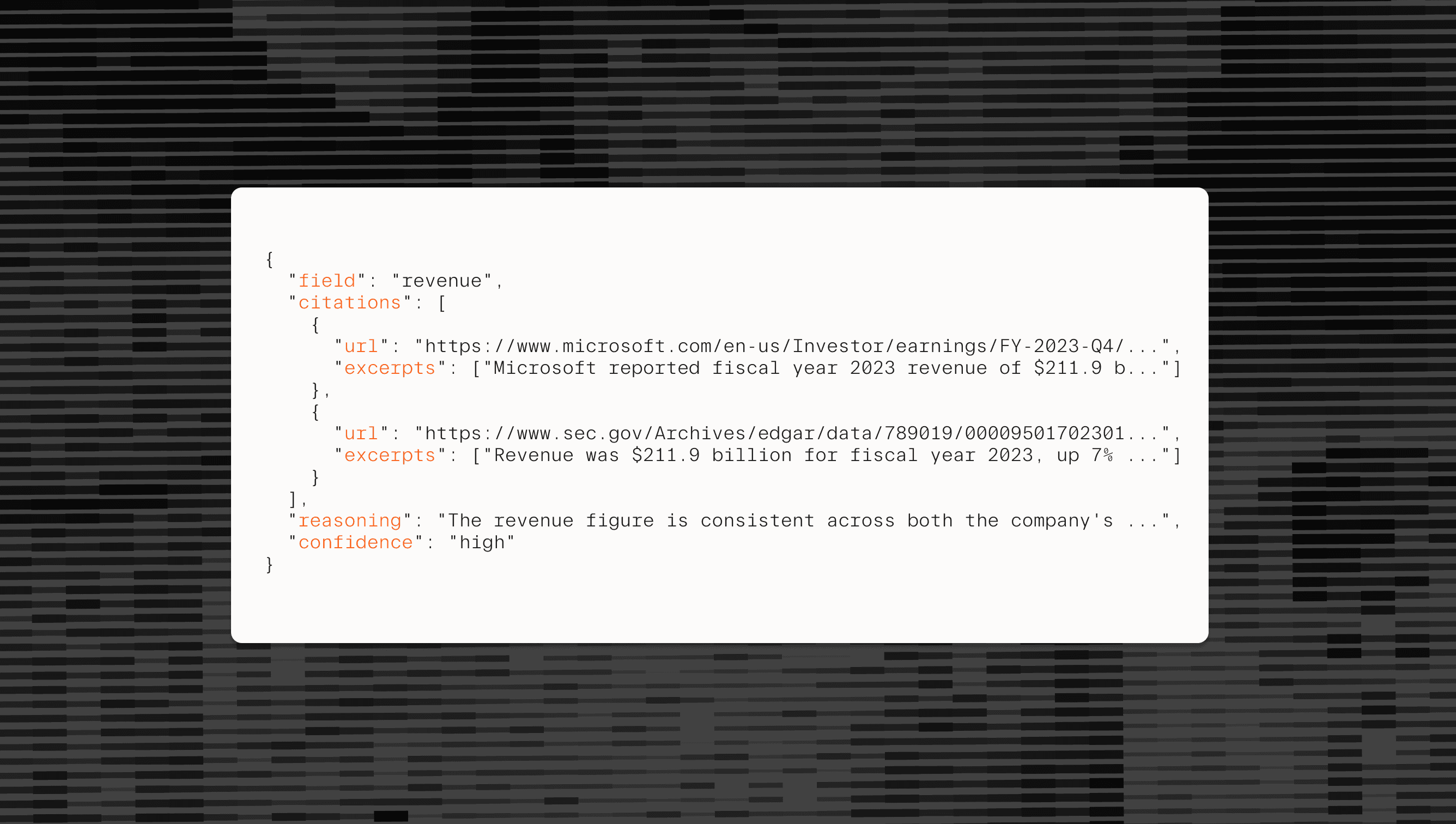
We recognize, however, that production use case don't just require pareto-optimal performance — they also require verifiability and calibrated confidence scoring and so today, we're excited to announce Basis — an essential suite of verification tools for the Parallel Task API.
Basis is an automatically included add-on to our Core, Pro, and Ultra processors that provide additional context and evidence around how we came to our conclusion, as well as how confident we are in our findings.
They allow you to identify instances where AI web research may yield unreliable results, enabling targeted human-in-the-loop workflows that efficiently focus human attention only where it's most needed. This strategic approach drastically reduces manual review hours while achieving significantly higher accuracy in hybrid human/AI workflows compared to either AI-only or human-only alternatives.
Basis provides a complete framework for understanding and validating Task API outputs through four core components:
These elements work together to create a robust framework for output verification that sets a new industry standard for transparency and reliability. For more information on Basis outputs in our Task API, go to docs[docs].
1234567891011{
  "field": "crm_system",
  "citations": [
    {
      "url": "https://www.linkedin.com/jobs/view/sales-representative-microsoft-dynamics-365-at-contoso-inc-3584271",
      "excerpts": ["Looking for sales professionals with experience in Microsoft Dynamics 365 CRM to join our growing team."]
    }
  ],
  "reasoning": "There is limited direct evidence about which CRM system the company uses internally. The job posting suggests they work with Microsoft Dynamics 365, but it's not explicitly stated whether this is their primary internal CRM or simply a product they sell/support. No official company documentation confirming their internal CRM system was found.",
  "confidence": "low"
}``` { "field": "crm_system", "citations": [ { "url": "https://www.linkedin.com/jobs/view/sales-representative-microsoft-dynamics-365-at-contoso-inc-3584271", "excerpts": ["Looking for sales professionals with experience in Microsoft Dynamics 365 CRM to join our growing team."] } ], "reasoning": "There is limited direct evidence about which CRM system the company uses internally. The job posting suggests they work with Microsoft Dynamics 365, but it's not explicitly stated whether this is their primary internal CRM or simply a product they sell/support. No official company documentation confirming their internal CRM system was found.", "confidence": "low"}``` Confidence ratings aren't particularly useful without calibration — you need to know that high, medium, and low labels provide useful and differentiable insight into task performance.
To calibrate confidence ratings, we’ve tested confidence patterns on composite datasets that reflect a wide array of real world use cases. Each composite dataset has varying levels of difficulty to demonstrate confidence performance and distribution across any web research task.
Why is this important?
When Parallel returns a higher percentage of Basis outputs as "High" Confidence, you can reliably interpret this as Parallel's Task API performing well on the Task.
You can use confidences as a proxy for a full evaluation, and understand how well your Tasks perform relative to each other.
Overall Dataset Accuracy (%)
HIGH CONFIDENCE RESPONSES (%)
OVERALL DATASET ACCURACY (%)
For each dataset (Easy, Medium, Hard) - the % of answers that are High Confidence compared to the overall accuracy % of the dataset.
As dataset queries get easier (ie higher overall accuracy %), the % of High Confidence responses increases.
This demonstrates confidences can reliably be used as a proxy for evaluating Parallel Processor performance on a dataset.
For each dataset (Easy, Medium, Hard) - the % of answers that are High Confidence compared to the overall accuracy % of the dataset.
As dataset queries get easier (ie higher overall accuracy %), the % of High Confidence responses increases.
This demonstrates confidences can reliably be used as a proxy for evaluating Parallel Processor performance on a dataset.
| Series  | Model  | High Confidence Responses (%) | Overall Dataset Accuracy (%) |
| ------- | ------ | ----------------------------- | ---------------------------- |
| Easy    | Easy   | 78                            | 91                           |
| Medium  | Medium | 72                            | 80                           |
| Hard    | Hard   | 53                            | 70                           |
For each dataset (Easy, Medium, Hard) - the % of answers that are High Confidence compared to the overall accuracy % of the dataset.
As dataset queries get easier (ie higher overall accuracy %), the % of High Confidence responses increases.
This demonstrates confidences can reliably be used as a proxy for evaluating Parallel Processor performance on a dataset.
By reviewing just the outputs rated as "Low" Confidence—a small portion of your total dataset—you can typically achieve an ~2x reduction in error rate, giving you significantly more leverage over human time compared to reviewing all outputs.
Outputs marked as "High" Confidence have 2-3X lower error rates than that of the overall dataset.
Basis is particularly valuable for hybrid AI-human workflows where the addition of AI significantly increases leverage, accuracy, and time efficiency. By focusing human review on outputs with low confidence, teams can dramatically reduce verification time while maintaining quality standards. This approach allows enterprises to scale their web research operations without sacrificing accuracy or transparency.
Today, Basis powers human-in-the-loop production workflows across numerous domains. Insurance underwriters leverage low-confidence indicators and citation trails to streamline KYB verification processes that were previously manual. AI automation platforms use Basis to validate data enrichment capabilities before pushing to production, providing traceability from enriched fields back to source materials.
The Basis framework with calibrated confidences is available today with the Parallel Task API. To start building with verifiable web research, go to the Parallel Developer Platform[Parallel Developer Platform].
**Testing Dates**: Testing was conducted between May 12 and May 15, 2025
**Benchmark Details**: The Parallel Confidence datasets cover easy, medium, and hard web research questions that all reflect a wide range of representative real world use cases. Three example questions are below.
**Example Questions**:
**Additional Data: **
| Category | Correct (%) | Incorrect (%) |
| -------- | ----------- | ------------- |
| High     | 97.2        | 2.8           |
| Medium   | 71.9        | 28.1          |
| Low      | 64.5        | 35.5          |
|          | 0           | 0             |
| High     | 97.5        | 2.5           |
| Medium   | 82.6        | 17.4          |
| Low      | 37.5        | 62.5          |
|          | 0           | 0             |
| High     | 85.9        | 14.1          |
| Medium   | 80          | 20            |
| Low      | 36.1        | 63.9          |
| Category | Incorrect ( ) | Correct ( ) |
| -------- | ------------- | ----------- |
| High     | 6             | 211         |
| Medium   | 9             | 23          |
| Low      | 11            | 20          |
|          | 0             | 0           |
| High     | 3             | 116         |
| Medium   | 4             | 19          |
| Low      | 10            | 6           |
|          | 0             | 0           |
| High     | 9             | 55          |
| Medium   | 4             | 16          |
| Low      | 23            | 13          |
Sep 28, 2026

Sep 28, 2026

Sep 28, 2026

Sep 24, 2026
Sep 23, 2026
Sep 18, 2026
Sep 15, 2026
Sep 10, 2026

Aug 31, 2026

Aug 29, 2026

Aug 25, 2026

Aug 21, 2026
Aug 19, 2026
Aug 13, 2026
Jul 30, 2026
Jul 21, 2026

Jul 20, 2026

Jul 16, 2026

Jul 15, 2026

Jul 13, 2026
Jul 12, 2026

Jul 10, 2026

Jul 8, 2026

Jun 9, 2026

Jun 5, 2026
Jun 4, 2026

May 20, 2026
May 19, 2026

May 7, 2026

May 5, 2026

Apr 29, 2026

Apr 29, 2026

Apr 24, 2026

Apr 23, 2026
Apr 21, 2026

Apr 20, 2026

Apr 8, 2026

Apr 8, 2026
Apr 7, 2026

Mar 30, 2026

Mar 25, 2026
Mar 19, 2026

Mar 18, 2026

Mar 17, 2026
Mar 10, 2026

Mar 4, 2026

Mar 2, 2026

Feb 23, 2026

Feb 4, 2026
Jan 28, 2026

Jan 21, 2026
Jan 15, 2026

Jan 8, 2026
Dec 17, 2025

Dec 16, 2025

Dec 11, 2025
Dec 10, 2025
Nov 20, 2025
Nov 18, 2025
Nov 13, 2025

Nov 12, 2025

Nov 11, 2025
Nov 6, 2025
Nov 3, 2025
Oct 30, 2025

Oct 23, 2025

Oct 22, 2025

Oct 17, 2025

Oct 16, 2025

Oct 9, 2025

Oct 8, 2025

Oct 7, 2025

Oct 6, 2025

Sep 30, 2025

Sep 16, 2025

Sep 12, 2025

Sep 11, 2025
Sep 9, 2025

Sep 5, 2025

Aug 21, 2025

Aug 14, 2025

Aug 7, 2025

Aug 5, 2025

Aug 4, 2025

Jul 31, 2025

Jul 31, 2025
Jul 28, 2025

Jul 14, 2025

Jul 8, 2025

Jul 2, 2025

Jun 17, 2025
Jun 10, 2025
May 30, 2025

Apr 24, 2025