

October 16, 2026
# The visibility value gap: why the most visible sites aren’t the most valuable to AI agents
The visibility value gap is the distance between how much exposure something gets and how much value it contributes. On the agentic web, we measure it for each domain as the difference between two ranks. One rank tracks AI visibility, and the other tracks value: the domain’s Shapley value based on its marginal contribution to answers.
## What is the visibility value gap?
The visibility value gap is the distance between how much exposure something gets and how much value it contributes. On the agentic web, we measure it for each domain as the difference between two ranks. One rank tracks AI visibility, and the other tracks value: the domain’s Shapley value based on its marginal contribution to answers.
Visibility counts the times a domain’s pages surface as AI agents[AI agents] look for answers. AI agents are software systems that use AI models to plan and act toward a goal, such as researching a question on the web. Value is the domain’s attributed share of the value those answers create.
In Parallel’s Visibility-Value Gap research[Parallel’s Visibility-Value Gap research], we ranked domains both ways and found the two lists overlap less than you’d expect. Some sites show up across a large share of results and add little at the margin. Others rank low on traffic leaderboards and carry outsized weight in agent answers.
You can measure exposure and contribution as separate quantities, and uniqueness decides which sources earn value.
## Where the term comes from: visibility vs. value in business
The phrase predates AI search. Business writers use it for any setting where the activity people can see diverges from the work that creates value, and three uses dominate.
### Productivity theater at work
At work, visibility means how noticeable your activity is to decision-makers, such as fast replies and meeting presence. In a July 2025 Forbes Business Council post[Forbes Business Council post], contributor Sabeer Nelliparamban used the heading “The Visibility-Value Gap (And What AI Has to Do With It).” He argued that many companies reward visible activity first, while value comes from quieter work such as deep thinking and solving complex problems.
Visier defines productivity theater as employees prioritizing performative work over more valuable tasks. Visier’s 2023 survey[Visier’s 2023 survey] of 1,000 US employees working full time found that 43% spent more than 10 hours a week on productivity theater tasks. It’s a 2023 vendor survey, so treat it as a dated signal that activity can crowd out valuable work.
### Onboarding and operations blind spots
Customer success teams talk about a “visibility-to-value” gap, meaning they can’t confirm whether a customer has reached first value. OnRamp’s 2026 onboarding report[OnRamp’s 2026 onboarding report] surveyed 161 customer success and onboarding leaders in Q4 2025.
OnRamp found that 62% can’t see customer progress in real time during onboarding. OnRamp sells onboarding software, so read the figure as vendor research.
If you can’t see whether a customer has reached first value, your team can’t act on that value.
### Brand visibility in AI answers
Marketers track how many times AI assistants mention or cite their brand. A mention count shows where your brand appears and can’t tell you whether the answer depended on your source.
Profound helps brands with answer engine optimization (AEO). In Profound’s AEO workflow[Profound’s AEO workflow], the team pairs AI visibility monitoring with our Search API and Task API. Profound uses them to fact-check drafts and research content that answer engines cite.
This context is where the term matters most, and our research adds the value measure.
## Why AI agents separate visibility from value
For decades, publishers measured the attention their content earned through pageviews, rankings, and impressions. With agents, you can measure a source’s contribution to the outcome as well.
Our research notes that agents reason in parallel and work in the background. Because they select sources on semantic content, we can measure a source’s contribution with some independence from exposure. The two measures agree in most cases, and you learn the most from the sources where they diverge.
| Visibility | Value | |
|---|---|---|
| What it measures | How much exposure a source gets | How much a source contributes to the outcome |
| Typical metrics | Pageviews, rankings, impressions, and mention counts | Shapley value, marginal contribution, and uniqueness |
| What it rewards | Ubiquity | Irreplaceability |
| Source | Web analytics and AI visibility dashboards | Parallel’s Visibility-Value Gap research and Index by Parallel |
Pew Research Center found[Pew Research Center found] that Google users who saw an AI summary clicked a traditional result in 8% of visits. Users without a summary clicked one in 15% of visits. Users clicked a link inside the summary in 1% of visits, based on March 2025 Google browsing data from 900 US adults.
In June 2025, Cloudflare measured Google crawling sites about 14 times for every referral, according to Cloudflare’s crawl-to-referral data[Cloudflare’s crawl-to-referral data]. OpenAI’s ratio was 1,700 to 1 and Anthropic’s was 73,000 to 1. These ratios move month to month, so read them as a dated snapshot.
For background on the fetch side, read our explainer on how AI crawlers work[how AI crawlers work].
The web’s primary user is shifting to machines, and we built Parallel for the web’s second user[the web’s second user]. Business models that run on attention can’t serve that user, so publishers need a second measure of what their content is worth.
## How to measure value with Shapley values
Encyclopaedia Britannica credits Lloyd Shapley’s 1953 work[Lloyd Shapley’s 1953 work] with the Shapley value. In a cooperative game where players make unequal contributions, the Shapley value determines the fairest distribution of payoffs.
Our research reduces the idea to one question for each player.
> “If you removed this player from the team, how much worse would the outcome be?”
Contributions aren’t additive, because they’re entangled and depend on order. A fair calculation averages each player’s marginal contribution across all possible permutations of the team, and the combinatorial cost grows with each player you add.
In their 2019 Data Shapley paper[Data Shapley paper], Amirata Ghorbani and James Zou used Shapley values to quantify each training datum’s value to a model’s performance. They built Monte Carlo and gradient methods to estimate those values at scale. Their work concerns training data, so we cite it as precedent for the math.
We apply the idea to content, where each source is valuable to the degree that answer quality would suffer without it.
In May 2026, we launched Index by Parallel[we launched Index by Parallel] to estimate each source’s Shapley value at the moment of inference and compensate participating content owners. Site owners see which queries their content answers and how unique its contribution is. Content that’s hard to replace or that supports valuable agent work earns more.
Parag Agrawal, founder and CEO of Parallel Web Systems, described the goal in the Index launch announcement[Index launch announcement] on PR Newswire in May 2026.
> “If your content helps agents do valuable work, we want you to be able to see that use, understand it, and partner with us to get compensated.”
## The four quadrants of the visibility value gap
Plot each domain by visibility against value, and you get four groups.
- - **Expected winners:** High visibility and high value. Agents surface these domains at high rates, and answers draw real weight from them.
- - **Overexposed:** High visibility and low value. Agents cite them at high rates, and other sources can replace them with little loss.
- - **Underrated:** Low visibility and high value. Agents surface them at lower rates, and the answer depends on them once agents cite them.
- - **Long tail:** Low visibility and low value. These domains surface at low rates and add little at the margin.
The table lists the most underrated and most overexposed domains in our data. Gap is the distance between a domain’s visibility rank and its value rank.
| Most underrated domain | Value rank | Gap | Most overexposed domain | Value rank | Gap |
|---|---|---|---|---|---|
| arxiv.org | 37 | 98 | ziprecruiter.com | 90 | 67 |
| homedepot.com | 56 | 64 | scribd.com | 122 | 60 |
| fda.gov | 64 | 51 | medium.com | 108 | 57 |
| fsri.org | 70 | 43 | whitepages.com | 135 | 56 |
| census.gov | 49 | 41 | investing.com | 107 | 52 |
| target.com | 44 | 36 | globaldata.com | 117 | 51 |
Agents go to arxiv.org because it’s the original location of many findings, so they get the actual number from the source. The fda.gov domain holds the authoritative record of the fact itself, and homedepot.com supplies live price and stock data that few other sources can match.
We tracked 381 domains over one week of Index activity, the week of May 25, 2026, and 219 appeared in both metrics. The data skews toward enterprise use cases, so treat these rankings as an early read.
## Why the gap happens: uniqueness beats ubiquity
The mechanism is uniqueness. Marginal contribution collapses once information becomes substitutable. If a hundred sites report the same fact, each earns little at the margin, though agents may cite all of them.
A single source that holds information no other site has is worth more at the margin. In our framing, visibility rewards ubiquity and Shapley value rewards irreplaceability.
We observed several patterns in the data. Local news punches above global news, and niche Substack categories outcompete traditional outlets. Domains behind heavy paywalls can see their Shapley values collapse as their visibility grows.
Columbia researchers documented one way copies absorb credit. A March 2025 Tow Center study[Tow Center study] in Columbia Journalism Review tested eight AI search tools on matching quotes to their sources. The researchers found the tools fabricated links and cited syndicated and copied versions of articles, so copies can collect visibility the original earned.
BuzzStream’s 2025 robots.txt study[BuzzStream’s 2025 robots.txt study] covered the top 50 US and top 50 UK news sites. It found that 79% block AI training bots and about 71% block retrieval bots. Robots.txt sets a directive that bots can ignore, and we haven’t tested whether blocking relates to the paywall pattern in our data.
## How publishers can close the visibility value gap
For two decades, publishers optimized for visibility because search traffic paid for their work. On the agentic web, uniqueness is the better target.
Our research found that original reporting and proprietary data outperform syndicated content. You can act on that finding in four steps.
### 1. Find where your content is substitutable
Pick your most important claims and data points, and check how many other pages say the same thing. Parallel Search API[Parallel Search API] takes a natural language objective and returns ranked URLs with dense excerpts. You can use it to find the pages that cover the same claim.
Parallel Extract API[Parallel Extract API] pulls clean content focused on your objective from each URL. You can compare what other pages repeat and what they miss.
Pages that restate facts available across the web sit in the overexposed or long tail zone. Pages with data no one else has are candidates for the underrated zone. We propose this as an audit workflow, and we haven’t published measured results from it.
### 2. Measure contribution alongside exposure
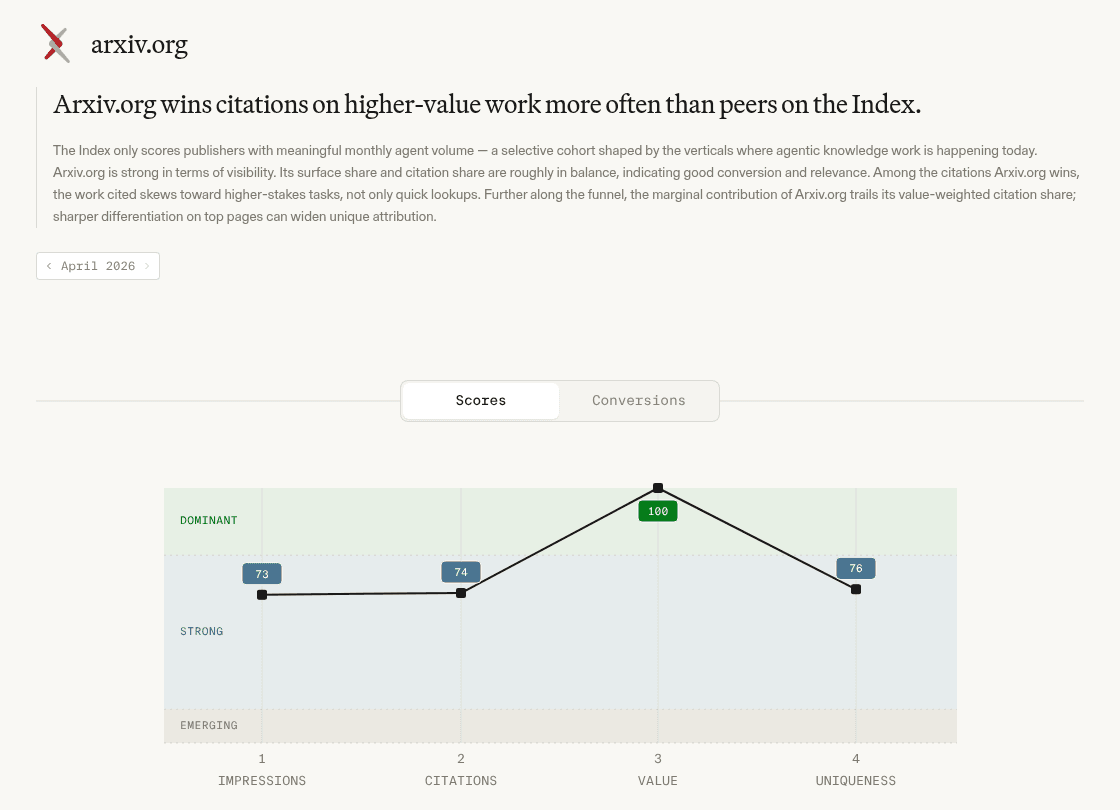
Index by Parallel gives site owners with meaningful monthly agent volume four scores for their domain:
- - **Impressions:** the rate at which agents surface your content, which we call “SEO impressions for the AI web”
- - **Citations:** the rate at which agents cite your content once they surface it
- - **Value:** how valuable the tasks that cite your content are
- - **Uniqueness:** how hard your content is to replace
The public arxiv.org demo dashboard[arxiv.org demo dashboard] from April 2026 scores impressions at 73 and citations at 74 out of 100. Value reaches 100 and uniqueness 76, so arxiv.org ranks high on visibility and tops the value scale. You can read the spread between your own scores as a guide to where to invest.
### 3. Publish the primary source
The underrated domains share one trait. Agents go to them for the original record, such as a study’s findings or a regulator’s approval.
Invest in original reporting, proprietary data, firsthand expertise, and clear primary records. Google’s helpful content guidance[Google’s helpful content guidance] asks a matching self-assessment question: “Does the content provide original information, reporting, research, or analysis?” Google asks whether content avoids copying or rewriting its sources, which points the same direction as agent value.
### 4. Watch for new substitutes
Uniqueness decays once others restate your data. Parallel Monitor API[Parallel Monitor API] tracks a natural language query on an hourly, daily, or weekly schedule and sends a webhook event as new relevant pages appear. You’ll see when others republish your findings, so you can refresh or extend the original.
## What the visibility value gap means for AI builders
If you build agents, the gap points to the source of answer quality. Your agent’s best answers depend on the sources it can’t replace. Retrieval that ranks by human popularity signals will overweight overexposed domains and add tokens without adding value.
Our Search API ranks URLs by how useful the page content is for the agent’s next reasoning step. Traditional SEO signals don’t set the order. Transparent attribution lets you trace which sources an answer depended on, so you can check where your agent’s quality comes from.
## The path forward: contribution as the currency of the agentic web
The visibility value gap changes how you plan content. Exposure counts, and contribution decides what a source is worth to agents.
We built Index by Parallel to measure contribution and route value back to the sources that earn it. Our first read skews toward enterprise use cases, and we expect the picture to broaden as the mix of agent work grows.
**Ready to get started?**
Content owners can Join the Index[Join the Index] to see how agents use their work. Developers can Start building[Start building] with our APIs. Enterprise teams can Contact sales[Contact sales] to discuss security and support requirements.
## FAQs about the visibility value gap
### What are the different types of visibility?
Workplace visibility is how noticeable your work is to decision makers, and operational visibility is a live view of customers, systems, or content. Brand visibility in AI answers tracks how many times assistants surface you, and agentic web visibility counts a domain’s appearances for AI systems. Each one contrasts with value, the contribution the work or source makes.
### What does visibility mean at work?
Visibility at work is how noticeable your contributions are to the people who decide recognition and pay. Visible behaviors, such as fast replies and meeting presence, can diverge from the work that creates value.
### Why isn’t strong work translating into recognition?
Recognition follows what decision makers can see. Decision makers don’t record quiet work unless someone connects it to outcomes. Following the Forbes contributor’s idea of proof of impact, tie each deliverable to the decision or metric it affects.
### How does AI widen the visibility value gap?
At work, AI makes polished output cheap, so people can fake activity with less effort. On the web, AI answers reduce clicks, so visibility brings less traffic. Agents reward unique contribution, which gives publishers a measure beyond exposure.
### Why do exposure metrics fail in AI search?
Mention counts and impressions measure presence, and they can’t tell you whether an answer depended on a source. An overexposed domain can appear in many answers and remain easy to replace. Contribution metrics such as Shapley value ask how much worse the answer would be without the source.