
September 8, 2026
# Knowledge retrieval API
A knowledge retrieval API is a service that takes a query and returns the most relevant content from a knowledge source, with relevance scores and source references rather than a generated answer.
## What is a knowledge retrieval API?
It queries organizational or web knowledge sources and returns ranked, relevant passages with citations. It hands your application the source content it needs rather than a finished answer from a model.
A general search API matches keywords and returns links. It adds semantic understanding, a backing knowledge base, reranking, and source references, so results stay accurate and easy to audit.
This matters because it grounds AI apps in verified content. Retrieval-augmented generation, or RAG, is now common in production. RAG reached 51% adoption[RAG reached 51% adoption] among enterprises in late 2024, up from 31%, per a Menlo Ventures survey of 600 U.S. IT decision-makers.
## Key characteristics
- - **Semantic matching:** It reads the intent behind a query rather than matching exact keywords, a technique known as semantic search.
- - **Knowledge source backing:** It draws results from indexes, stored documents, or the live web.
- - **Relevance scoring and reranking:** It scores each candidate passage and returns only results that clear a reranker threshold.
- - **Source references:** It attaches citations to every passage so you can trace where an answer came from.
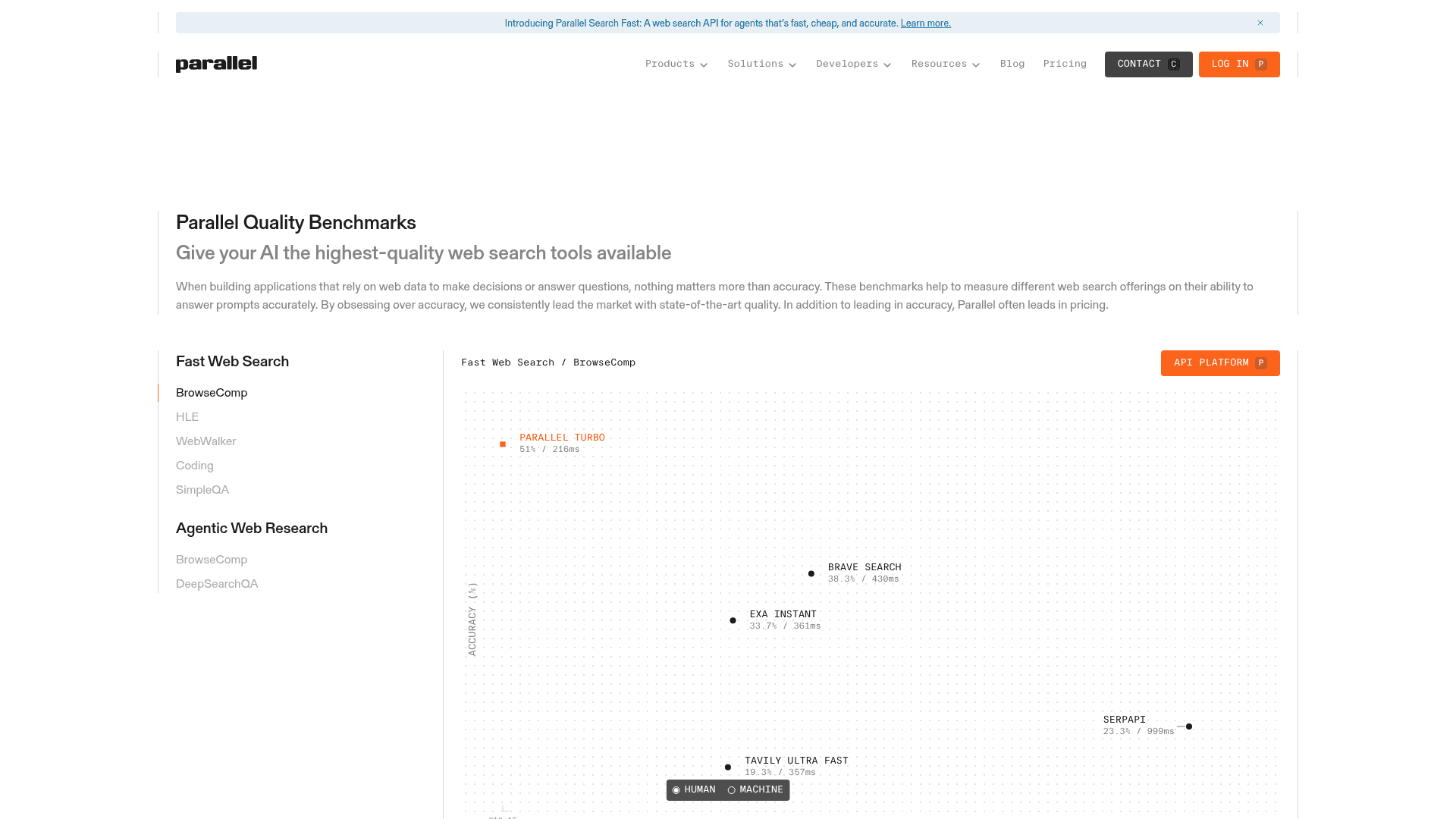
_Retrieval quality sets the ceiling on how well grounded AI answers can be. Parallel’s benchmarks page[benchmarks page] compares web search API accuracy across providers._
## Example
Picture a support assistant built as one of your AI agents. A user asks how to rotate an API key. The assistant sends that question to a retrieval API, which returns the three most relevant passages from your docs with links.
The assistant passes those passages to a large language model (LLM), which writes a short reply and cites each source. Your user gets a grounded answer, and your team can trace every claim to a document (or web page).
Parallel’s Search API[Parallel’s Search API] is one example of a real retrieval API that AI agents call this way.
## Related terms
- - Web search API[Web search API]: a retrieval API that queries the live web.
- - Semantic search[Semantic search]: the matching technique behind it.
- - Deep research[Deep research]: chained multi-source retrieval.
- - AI agents[AI agents]: common consumers of retrieval APIs.
## FAQ
**How is a knowledge retrieval API different from RAG?**
Retrieval is the first step, finding relevant content. RAG adds a generation step where an LLM writes an answer from that content, a pattern NIST describes[NIST describes].
**Does a knowledge retrieval API stop AI from making things up?**
It reduces errors by grounding answers in real sources, though it doesn’t remove them entirely. A Stanford legal research study[Stanford legal research study] found general LLMs hallucinate on legal queries 58% to 82%, versus 17% to 33% for retrieval tools built for law.
**What can a knowledge retrieval API query?**
It can query search indexes, stored documents, and web sources, returning ranked passages with references.