
September 8, 2026
# Agentic search
Agentic search is a pattern where an AI agent plans, runs, reads, and refines web searches in a reasoning loop, deciding what to query next based on what it finds, rather than making a single fixed retrieval call.
## What is agentic search?
An artificial intelligence (AI) agent turns research into a loop instead of a single lookup. The agent reads a goal, runs a search, studies the results, and picks its next query. Anthropic describes capable agents as generating their own search queries[generating their own search queries] instead of following a fixed script.
A system that runs one query, such as basic retrieval-augmented generation (RAG), returns a fixed set of results. The agent keeps looping until it gathers enough to answer. This helps AI agents that work through questions with several steps.
The loop moves through four stages: plan, search, read, and refine. The agent scores each result and decides whether to answer or search again. This search, read, and reason cycle separates the pattern from a plain lookup.
The agent pulls live web data, so it works from current pages instead of a frozen snapshot. When a first search misses, the agent rewrites the query and tries again. That recovery step is hard to copy with one static retrieval call.
Depth is the point. A single lookup answers one question, while the loop works through a chain of linked questions. The agent trades a little speed for answers that hold up under review.
You’ll find this pattern inside deep research assistants, coding agents, and market analysis tools. Each one needs current facts that a training set cannot hold. The agent fetches those facts on demand and reasons over them in the same turn.
The work scales with the task. A simple question may need one loop, while a research-heavy question may need many. The agent matches its effort to the goal in front of it.
## Key characteristics
Agentic search shares a few defining traits across implementations.
- - **Autonomous querying:** the agent writes and issues its own searches instead of running one preset query.
- - **Iterative loops:** the agent runs several rounds and refines each search, a process researchers call iterative and agent-directed[iterative and agent-directed].
- - **Higher multi-hop accuracy:** on closed-corpus multi-hop question-answering (QA) benchmarks, agentic retrieval has shown multi-hop accuracy gains[multi-hop accuracy gains] over single-shot RAG.
- - **Built for agents:** the agent needs dense, compact excerpts sized for an LLM context window, delivered through a web search API for agents[web search API for agents].
- - **Measurable quality:** teams score this pattern on benchmarks that reward heavy browsing and multiple rounds of research.
Autonomy is the biggest shift. The agent decides how many searches to run and when the answer is complete. Stronger reasoning models plan better queries and catch weak sources sooner.
Each extra loop adds latency and cost, so a good agent balances depth against budget. It reuses what it learns, skips repeat queries, and stops once the answer holds. Compact results keep every round affordable inside a limited context window.
A good agent knows when to stop. It checks whether its sources agree, whether key facts are missing, and whether another query would help. Clear stopping rules keep the loop from running long or wasting tokens on weak leads.
Grounding is part of the pattern. The agent keeps the pages it read and links each claim to a source. That trail lets a person verify the answer instead of trusting the model alone.
Conflicting sources are common on the open web. The agent can weigh a primary filing against a news summary and prefer the original document. When two pages disagree, it runs another search to break the tie before it answers.
Freshness matters as much as accuracy. The agent can favor recent pages when a topic shifts fast, such as pricing, staffing, or litigation. It can re-run a search later to catch updates a first pass missed.
Parallel measures agentic search quality in its Agentic Web Research benchmark category, using tests such as DeepSearchQA and BrowseComp. These tests reward agents that chain searches, read full sources, and cite them.
Enterprises are adopting these agents at pace. Forty percent of enterprise applications will be integrated with task-specific AI agents by the end of 2026, up from less than 5% today, according to Gartner Inc. Gartner shares this forecast in its report on 40% of enterprise apps by 2026[40% of enterprise apps by 2026].
## Example: a research agent working in a loop
Picture an analyst agent checking a supplier’s recent legal risks. The agent searches for lawsuits, reads a filing, and notices the verdict is missing. It runs a new search for the outcome and adds the source to its answer.
The agent repeats this loop for each open question, such as fines, appeals, and related parties. It stops once it can respond with confidence and citations. This pattern powers multi-step research automation[multi-step research automation], where one agent chains many searches and reads into a single answer.
A support agent can work the same way. It searches product docs, reads the closest match, and searches again when the fix does not match the user’s version. The agent returns a grounded answer with the exact page it used.
In both cases the agent hands back more than a link list. It returns a short answer, the reasoning path it took, and the pages behind each fact. A reviewer can trust the result or reopen the loop.
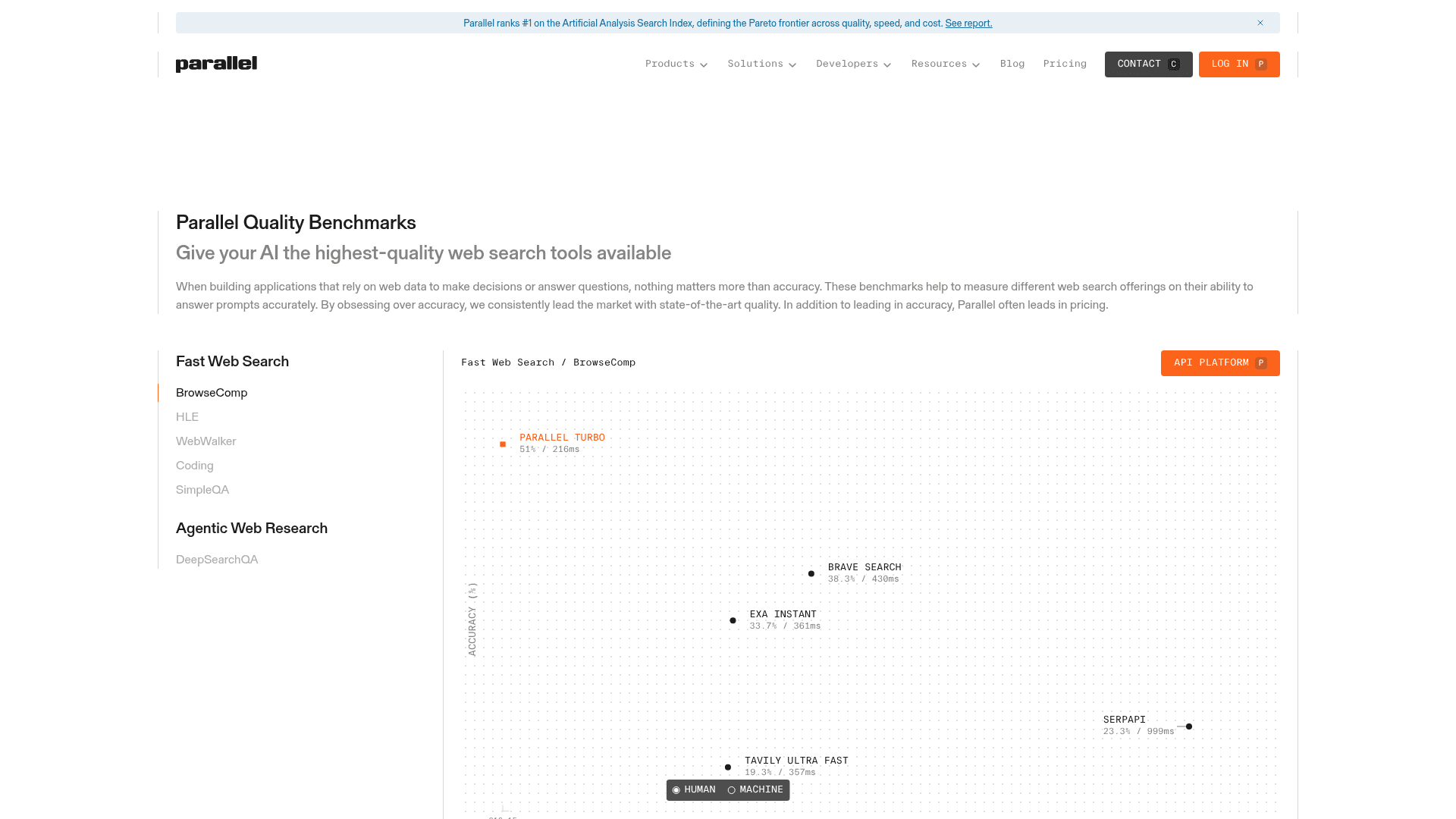
_Parallel’s benchmarks page compares agentic web research quality across providers. Source: Parallel benchmarks[Parallel benchmarks]._
## Related terms
- - **natural-language search objectives[natural-language search objectives]:** describe intent in plain language and receive agent-ready context.
- - **search as a tool call[search as a tool call]:** let an agent invoke web search inside its own loop.
- - **Parallel developer documentation[Parallel developer documentation]:** see how search, extraction, and research combine into an agentic pipeline.
## FAQ
**Is agentic search the same as RAG?**
No. RAG matches a fixed query against an existing index, while an agentic loop lets the model choose what to query and refine across rounds.
**Does agentic search require a reasoning model?**
No. A basic loop that searches and reads works with most large language models, though stronger reasoning helps the agent judge result quality mid-loop.
**Where does agentic search fit in an AI stack?**
Agentic search runs as a tool call inside an agent’s loop. It gives the model live web access it can invoke and re-invoke while working through a task.